
When back or neck pain keeps coming back, even simple things like sitting, walking, bending, or getting a good night’s sleep can become difficult. You may have tried resting, stretching, or taking pain medication, but the discomfort still affects your daily life. If you’re looking for a non-surgical way to manage your pain, spinal decompression may be worth learning about.
But what is spinal decompression, and how does it work?
Spinal decompression is a treatment that gently stretches the spine to help reduce pressure on spinal discs and nearby nerves. It may help people with back pain, neck pain, or pain caused by irritated nerves. The treatment does not involve surgery, and the results depend on the cause of your symptoms.
In this guide, you’ll learn how spinal decompression works, its possible benefits, costs, safety, and what to expect during treatment. You’ll also find out who may benefit from it and whether it’s the right option for your condition.
What Is Spinal Decompression?
Spinal decompression is a treatment designed to relieve pressure on structures within the spine, including discs and nearby nerves.
Your spine contains a series of bones called vertebrae. Between most of these bones are soft, flexible discs that help absorb shock and allow comfortable movement.
When a disc becomes damaged, bulges outward, or presses against a nerve, it can sometimes cause pain, tingling, numbness, or discomfort that travels into an arm or leg.
Spinal decompression aims to reduce mechanical pressure by creating a controlled stretching force along the spine.
There are two main types of spinal decompression.
Non-Surgical Spinal Decompression
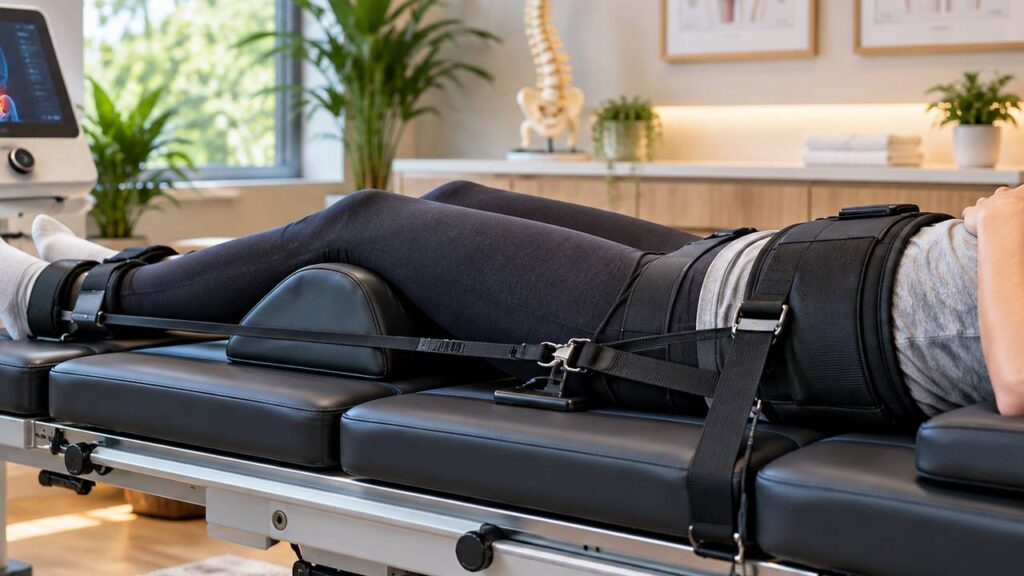
Non-surgical spinal decompression uses a mechanical traction table or another device to gently stretch the spine.
The goal is to temporarily change the forces acting on spinal structures, which may reduce discomfort for certain patients.
This approach does not require an incision, anesthesia, or a hospital stay.
Surgical Spinal Decompression
Surgical spinal decompression is an operation used to relieve pressure on compressed spinal nerves or the spinal cord.
A surgeon may remove part of a bone, disc, or another structure responsible for the compression.
Surgery is generally considered when a condition causes serious neurological problems or when appropriate conservative care has not provided enough improvement.
For the rest of this article, spinal decompression refers mainly to non-surgical treatment.
How Does Spinal Decompression Therapy Work?
Non-surgical spinal decompression works by applying a gentle pulling force to the spine.
During treatment, a mechanical table slowly stretches and relaxes the targeted area. The pulling force can be adjusted based on the patient’s body, symptoms, and treatment needs.
This process is intended to reduce pressure on certain spinal structures.
Some devices are designed to create changes in pressure inside the spinal discs. However, claims that treatment consistently pulls herniated discs back into place or permanently repairs damaged discs have not been established by strong clinical evidence.
The main goal is to help manage symptoms and support more comfortable movement when traction is appropriate.
What Happens During a Spinal Decompression Session?
A typical appointment may include the following steps:
-
Preparation: Your provider reviews your symptoms and confirms that decompression is appropriate for your condition.
-
Positioning: You lie on a treatment table, either face-up or face-down, depending on the device and treatment area.
-
Support: A harness or support system may be placed around your hips or upper body.
-
Gentle stretching: The device applies a controlled pulling force, sometimes alternating between stretching and relaxation.
-
Reassessment: Your provider checks how you feel and whether symptoms have changed after treatment.
A session may take approximately 20–45 minutes, although the actual time depends on the equipment and treatment plan.
You can usually return to normal light activities afterward unless your provider recommends temporary changes.
What Conditions May Benefit From Spinal Decompression?
Spinal decompression may be considered for certain spinal conditions, especially when symptoms suggest that a nerve is being irritated.
However, having one of these conditions does not automatically mean decompression is the right treatment.
Herniated or Bulging Discs
A herniated or bulging disc can sometimes irritate a nearby spinal nerve.
This may cause back pain, leg pain, neck pain, or symptoms that travel into an arm.
Mechanical traction may be considered for selected patients with disc-related nerve symptoms. It is not proven to permanently repair a damaged disc.
Sciatica
Sciatica describes pain that travels along the path of the sciatic nerve, often from the lower back into the buttock or leg.
For certain patients with lumbar nerve root irritation, traction may offer short-term symptom relief when combined with other conservative treatments.
The underlying cause of sciatica should be identified before beginning care.
Degenerative Disc Disease
Spinal discs naturally change as people age. Some become thinner, less flexible, or more prone to irritation.
When these changes are associated with back pain or nerve symptoms, a provider may consider several conservative treatments.
Decompression may be one option, but it does not reverse normal disc aging.
Spinal Stenosis
Spinal stenosis occurs when spaces within the spine become narrow enough to affect nearby nerves or the spinal cord.
Treatment depends on the severity and location of the narrowing.
Traction is not a proven treatment for spinal stenosis in general. Patients with significant narrowing or neurological symptoms need careful evaluation before considering it.
What Are the Benefits of Spinal Decompression?
The possible benefits of spinal decompression mainly relate to symptom management, movement, and the ability to take part in normal activities.
Reduced Discomfort From Nerve Irritation
Selected patients may experience less radiating pain when mechanical traction is included in a suitable treatment plan.
More Comfortable Movement
Reduced discomfort may make it easier to bend, walk, sit, or participate in exercises intended to improve spinal function.
A Non-Invasive Treatment Option
Unlike surgery, non-surgical decompression does not involve incisions or general anesthesia. Most patients do not need a surgical recovery period.
Another potential advantage is that decompression can be considered alongside exercise, education, and other appropriate conservative treatments.
These are possible benefits rather than guaranteed results. The treatment may not provide additional improvement for everyone.
Does Spinal Decompression Work?
Does Spinal Decompression Work?
Spinal decompression may help people with certain types of back pain and nerve-related symptoms, but the overall research results are mixed.
Some clinical studies suggest that mechanical traction can offer short-term pain relief for selected patients with lumbar radiculopathy, a condition involving irritated nerve roots in the lower back.
However, other studies have found limited or no meaningful improvement compared with exercise-based or other conservative treatments.
Research also has not shown that computer-controlled spinal decompression is consistently better than conventional mechanical traction.
A systematic review of mechanical traction for lumbar radiculopathy found possible short-term benefits with some traction approaches, although the strength of the evidence varied.
What Affects the Results?
Several factors can influence whether treatment helps:
-
The actual cause of your back or neck pain
-
Whether symptoms involve an irritated nerve
-
Your overall spinal health
-
Other treatments included in your care
-
Your response to the first few sessions
-
Whether you can safely continue normal movement and exercise
A helpful treatment plan should have clear goals, such as reducing leg pain, improving walking tolerance, or making daily activities easier.
If you are not improving, your provider should reassess your symptoms rather than automatically recommending more sessions.
Is Spinal Decompression Safe?
Non-surgical spinal decompression is generally a low-risk procedure for appropriately screened patients. However, it is not suitable for everyone.
A qualified healthcare provider should review your medical history, examine your spine, and check for conditions that could make traction unsafe.
Who Should Avoid Spinal Decompression?
Mechanical traction may be unsuitable or require special medical assessment for people with:
-
Spinal fractures or unstable spinal conditions
-
Severe osteoporosis
-
Spinal tumors or infections
-
Certain spinal implants or recent spinal surgery
-
Pregnancy, particularly for lumbar traction
-
Significant spinal cord compression or worsening neurological symptoms
-
Certain vascular conditions
Having spinal hardware does not automatically rule out every treatment, but it requires an individualized assessment.
What Are the Possible Risks?
Some people may experience temporary muscle soreness, increased discomfort, or a short-term flare-up of symptoms.
More concerning symptoms, such as new weakness, worsening numbness, or increasing pain traveling into an arm or leg, should be reported promptly.
Treatment should not continue through sharp pain or worsening neurological symptoms.
The safest approach is to begin with a proper diagnosis and use treatment settings appropriate for your condition.
Does Spinal Decompression Hurt?
For many people, spinal decompression feels like a gentle, steady stretch rather than a painful procedure.
You may notice tension around your lower back, hips, or neck while the device applies traction.
Some patients find the experience comfortable, while others feel mild soreness afterward.
Spinal decompression should not cause severe pain.
If the pulling sensation is uncomfortable, or if pain, tingling, or numbness becomes worse, tell your provider immediately.
The treatment force may need to be adjusted, stopped, or reconsidered.
Feeling a stronger stretch does not mean the treatment will work better.
How Long Does Spinal Decompression Last?
The effects of spinal decompression can last for different amounts of time depending on your condition and how your body responds.
Some people notice temporary relief after a session. Others may experience gradual improvements over several visits. Some patients do not experience meaningful benefits.
There is no reliable way to promise that relief will last for a certain number of weeks or months.
How Many Spinal Decompression Sessions Are Needed?
Treatment schedules vary between providers and patients.
Some clinics recommend multiple appointments per week over several weeks, while others use shorter treatment plans.
The right number of sessions depends on your diagnosis, symptoms, progress, and treatment goals.
A plan involving 12–20 sessions may be offered by some clinics, but this is not a proven requirement for everyone.
Your provider should explain why a particular schedule is recommended and when your progress will be reviewed.
How Can You Maintain Your Progress?
If decompression helps relieve your symptoms, maintaining comfortable movement and improving strength may help support your overall recovery.
Useful habits include:
-
Staying physically active within your comfort level
-
Following an appropriate strengthening program
-
Taking regular movement breaks during long periods of sitting
-
Using comfortable lifting techniques
-
Gradually returning to activities you enjoy
-
Following up when symptoms change or return
The goal is to improve your ability to move and manage everyday activities, not to depend on treatment sessions indefinitely.
What Is the Success Rate of Spinal Decompression?
There is no scientifically established success rate that applies to everyone receiving non-surgical spinal decompression.
You may see claims online that spinal decompression has a 70%–90% success rate. However, these figures should not be presented as a reliable average for all patients.
Different studies use different treatment methods, patient groups, follow-up periods, and definitions of success.
For example, one study may measure pain reduction, while another measures improvements in daily activity.
A person who experiences short-term pain relief may have a different outcome from someone who maintains improvement for several months.
Instead of focusing on one percentage, ask your provider what improvement is realistic for your specific condition.
Meaningful progress may include sleeping better, walking farther, experiencing fewer radiating symptoms, or returning to activities that were previously uncomfortable.
How Much Does Spinal Decompression Cost?
The cost of spinal decompression depends on the clinic, equipment, number of sessions, and whether other treatments are included.
In the United States, non-surgical spinal decompression commonly costs around 50–150 per session, although some clinics charge more.
For context, recent published cash-price examples fall within this general range, but there is no single nationwide standard price.
Treatment expense |
What to expect |
|
Initial consultation |
May be charged separately |
|
Individual decompression session |
Approximately 50–150 at many clinics |
|
Multiple-session treatment plan |
Depends on the number of visits and services included |
|
Imaging or additional treatment |
May involve separate charges when needed |
These figures are general estimates, not verified prices for Orenda Chiropractic in Reno.
Before beginning treatment, ask for an itemized estimate and whether you can pay per session instead of purchasing a large package upfront.
Does Insurance Cover Spinal Decompression?
Insurance coverage varies by plan and the type of treatment provided.
Some insurers may cover medically necessary mechanical traction under certain circumstances. However, specialized non-surgical decompression programs are often excluded or require out-of-pocket payment.
Original Medicare does not generally cover non-surgical spinal decompression when provided as a chiropractic traction service.
Medicare Part B covers only certain medically necessary spinal manipulation services performed by chiropractors, rather than every chiropractic treatment.
Before treatment, confirm your benefits, possible copayments, deductibles, and any required authorization.
Does Spinal Decompression Make You Taller?
Spinal decompression does not permanently increase your height.
Your spinal discs naturally compress slightly during daily activities, especially when you spend time standing or sitting.
Resting and lying down can temporarily reduce some of that compression.
Traction may also cause small, temporary changes in spinal spacing, but these changes are not the same as permanent growth.
Non-surgical decompression does not lengthen your bones or make your spine permanently taller.
If your goal is to improve posture or stand more comfortably, appropriate strength, mobility, and movement exercises may be more useful than focusing on height.
Can Spinal Decompression Exercises Help?
Spinal decompression exercises are movements intended to reduce discomfort, improve mobility, or help you find more comfortable positions.
Unlike mechanical traction, exercises involve active movement and muscle control.
For people with uncomplicated back pain, appropriate movement and exercise are often important parts of conservative care.
Gentle Walking
Walking can help you stay active without placing excessive demands on your back.
Begin with a comfortable distance and gradually increase your walking time as tolerated.
Pelvic Tilts
Pelvic tilts involve gently moving the pelvis while lying on your back with your knees bent.
They can help you practice controlled movement of the lower back.
Gentle Knee-to-Chest Stretch
Some people find that bringing one knee toward the chest provides a comfortable stretch.
However, bending the spine may worsen symptoms for certain disc-related conditions, so this exercise is not suitable for everyone.
Exercises that help one person may aggravate another person’s symptoms.
Before trying spinal decompression exercises, speak with a qualified healthcare provider, particularly if you have a herniated disc, radiating pain, numbness, or a previous spinal injury.
Avoid aggressive hanging, forceful stretching, or attempting to reproduce clinical traction with homemade devices.
Spinal Decompression vs. Chiropractic Adjustments
Spinal decompression and chiropractic adjustments are different treatment approaches.
Spinal decompression |
Chiropractic adjustments |
|
Uses a controlled stretching force |
Uses a manual or instrument-assisted force |
|
Often performed using a traction device |
Usually performed by a chiropractor |
|
Aims to change mechanical loading on the spine |
Aims to improve joint movement and manage certain musculoskeletal symptoms |
|
May be considered for selected nerve-related symptoms |
May be considered for certain types of back or neck pain |
Neither treatment is right for every person.
In some situations, a chiropractor may consider both approaches as part of a broader treatment plan. In other cases, exercises, physical therapy, medication, or referral for medical evaluation may be more appropriate.
The best choice depends on the diagnosis and your individual needs.
When Should You Seek Medical Care for Back or Neck Pain?
Many cases of back or neck pain improve with conservative treatment. However, some symptoms require prompt attention.
Seek emergency medical care if you develop new loss of bladder or bowel control, numbness around the groin, or rapidly worsening leg weakness.
Prompt medical assessment is also important if you have severe pain after an accident, fever with significant back pain, or new neurological symptoms.
If pain continues despite appropriate conservative care, reassessment can help determine whether additional testing or another treatment approach is needed.
Spinal Decompression Therapy at Orenda Chiropractic in Reno, NV
If you have ongoing back pain, neck discomfort, or symptoms that travel into an arm or leg, understanding the cause of your symptoms is an important first step.
At Orenda Chiropractic, Dr. Travis Rodman and the chiropractic team serve patients in Reno, Nevada.
The clinic’s listed services include:
A chiropractic evaluation can help identify the nature of your symptoms and determine whether conservative treatment may be appropriate or whether further medical assessment is needed.
For patients considering spinal decompression therapy in Reno, discussing expected benefits, limitations, safety, and costs before starting treatment can help them make an informed decision.
Book a Chiropractic Appointment in Reno
If back or neck pain is affecting your daily routine, contact Orenda Chiropractic to discuss your symptoms and available treatment options.
Book your appointment with Orenda Chiropractic and learn whether spinal decompression or another approach may be suitable for your needs.
Location: Reno, NV
Website: Chiropractor in Reno, NV
Phone: (775) 636-7611
Map: Orenda Chiropractic – Reno, NV
Final Thoughts
So, what is spinal decompression, and should you consider it for back or neck pain?
Spinal decompression is a non-surgical approach that uses controlled traction to gently stretch the spine. It may help some patients manage certain types of nerve-related back pain, particularly when used alongside other appropriate conservative treatments.
Its main advantages are that it does not require surgery or anesthesia and can be adjusted based on individual treatment needs.
However, it is not a guaranteed solution, and research has not shown consistent benefits for every spinal condition.
The most useful next step is to understand what is causing your symptoms, discuss your treatment options, and choose care based on your needs and medical history.
Frequently Asked Questions
Can spinal decompression fix a herniated disc?
Spinal decompression may help reduce symptoms associated with a herniated disc in some patients. However, it has not been proven to permanently repair a herniated disc or reliably return displaced disc material to its original position.
Does spinal decompression work for sciatica?
Mechanical traction may provide short-term relief for selected patients with sciatica caused by lumbar nerve root irritation. Results vary, and treatment is often considered alongside exercise and other conservative care.
Can you walk after spinal decompression?
Most patients can walk and return to light daily activities after non-surgical spinal decompression. Your provider may suggest temporary activity changes based on your symptoms and how you respond to treatment.
How often should you get spinal decompression?
There is no standard treatment frequency that works for everyone. Some clinics schedule multiple visits per week, but the number of appointments should depend on your diagnosis, response, and progress toward treatment goals.
Is spinal decompression better than surgery?
Spinal decompression therapy is less invasive than surgery, but the two treatments serve different purposes. Non-surgical traction may help manage symptoms in selected patients, while surgery may be needed for serious nerve or spinal cord compression. The appropriate choice depends on the diagnosis.
Can spinal decompression make back pain worse?
Some patients experience temporary soreness or increased discomfort after treatment. If pain becomes severe or neurological symptoms worsen, stop treatment, and the patient should undergo further evaluation.